



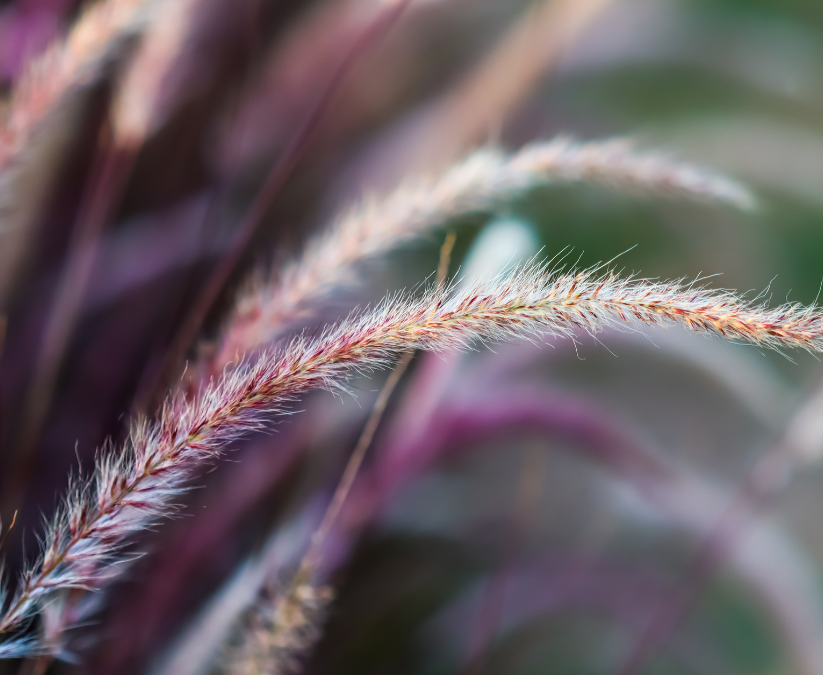
Purple Fountain Grass can provide your landscape with beauty, texture, movement, and a plant that local birds will love. With fall in our reach, it’s a great time to get some ornamental grass into your yards. This is their time to shine.
The Beauty of Purple Fountain Grass
Let’s say it. One of the biggest reasons people choose the plants they do is because they love the way they look, right? Well, one look at purple fountain grass (Pennisetum setaceum ‘Rubrum’) when it is in full bloom, will you show you why it is one of our most sought-after ornamental grasses during the fall planting season. Gorgeous burgundy blades of grass grow in a gracefully arching form and are only surpassed in beauty when its flower stalks produce burgundy-purple, showy, feathery plumes in fall. The look of the entire plant is reminiscent of a fountain spraying water, which is most definitely how this grass got its name.
The clumping foliage of purple fountain grass only reaches about 3 feet at maturity, but the plant tops out at about 5 feet with the addition of its flower stalks and feathery plumes. When the softer sunlight of fall and winter arrives, it practically glows through the airy, feathery plumes. We love displaying purple fountain grass in a multitude of ways. They are considered a tender perennial here in San Antonio, with a hardiness zone of 9 – 10, so they can be planted in landscape beds (just watch the weather in winter in case of a deep freeze). In containers, purple fountain grass makes an excellent “thriller” plant, whether placed in the middle or back of a pot surrounded with shorter “fillers and spillers”, or as a stand-alone container specimen. Just keep in mind that plants in containers tend to lose a few degrees of hardiness, so they may have to be covered or brought in for protection if temps dip down below 20º-25º F.
Texture and Movement of Purple Fountain Grass
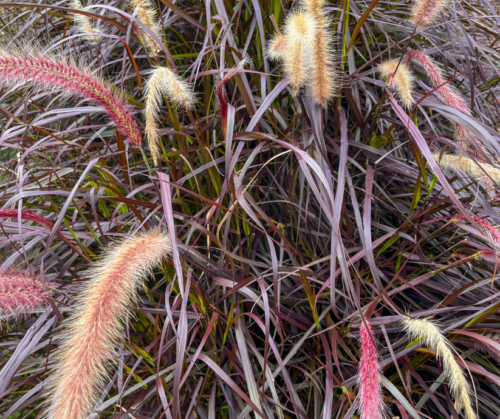
Despite its deep burgundy-purple coloring, the foliage never looks heavy; the fine leaves and airy plumes keep it light, wispy, and elegant. Purple fountain grass brings a soft, flowing texture to the landscape that adds movement wherever it’s planted. Long, slender, arching blades create a graceful, almost cascading appearance, while the feathery flower plumes rise above the foliage like soft bottlebrushes. When a breeze moves through, the entire plant seems to sway and ripple, giving garden beds a relaxed, natural feel. The sound of rustling foliage is better than windchimes to me.
That movement gives purple fountain grass a quality that many other landscape plants simply can’t provide. Instead of remaining still, it changes from moment to moment. Each gentle breeze allows the plant to catch the light differently as the foliage moves and the fuzzy plumes dance above. Planted in groups, the effect becomes even more dramatic, creating a flow, or rhythm in the landscape. What a great way to soften hard edges, break up dense plantings, and make a garden feel more alive.
Wildlife Loves Purple Fountain Grass
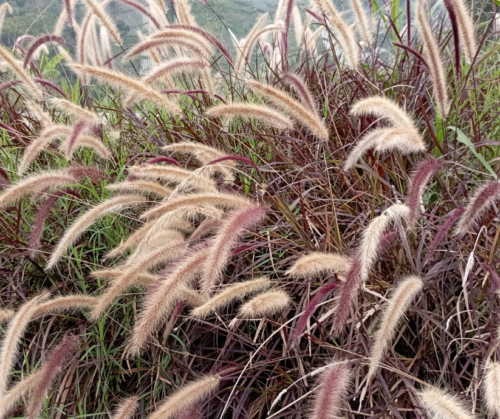
You’ll find that you aren’t the only one who enjoys having purple fountain grass in your landscape. Ornamental grasses are a favorite for our local wildlife. Birds take refuge in the dense foliage and delight in feasting on seedheads during wintertime. This is one of the reasons we strongly advise against pruning ornamental grasses after their foliage turns brown and plumes fade. Cutting back after fall removes the dry seedheads will provide nourishment for hungry birds at time when food sources become scarcer, and birds will still seek out the dry foliage for their habitats. Other garden wildlife can tuck themselves away from wind and cold and I’ve even found several butterfly chrysalises overwintering in there. Besides, I like the way the golden seedheads look in the winter sun, almost as much as I love the feathery plumes in fall. Wait until February to cut them back or allow them to die back to the crown in winter. It won’t set the growth of purple fountain grass back hardly at all.
Oh, one more thing about those seedheads. I’m sure I’ll hear something back about purple fountain grass not being a native species. Don’t get me wrong, here at Rainbow Gardens we love our native grasses. But we love our well-adapted plants that behave too. Purple fountain grass is a hybrid and the seeds that it produces are sterile. This means that while the plant produces attractive flower plumes, the seeds are not viable and cannot be used to grow new plants. Sterile seeds help reduce invasiveness compared to the species grass, which can self-seed aggressively in suitable climates and conditions.
Quick Look Growing Characteristics of Purple Fountain Grass
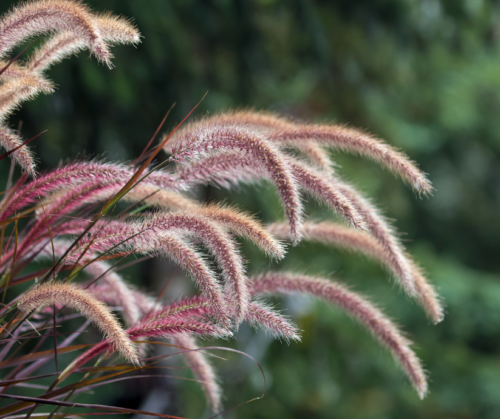
- Sun: Full sun to part shade
- Avg. Mature Growth: 3-5′ T x 2-4′ T
- Soil: Well-draining (include soil conditioner and/or expanded shale if you don’t have good drainage, or plant elsewhere)
- Water Needs: Average
- Bloom Season: Late summer – fall
Whether it is purple fountain grass or another ornamental grass you give a try this fall, I think you’ll love them as much as we do.
~The Happy Gardener, Lisa Mulroy


