



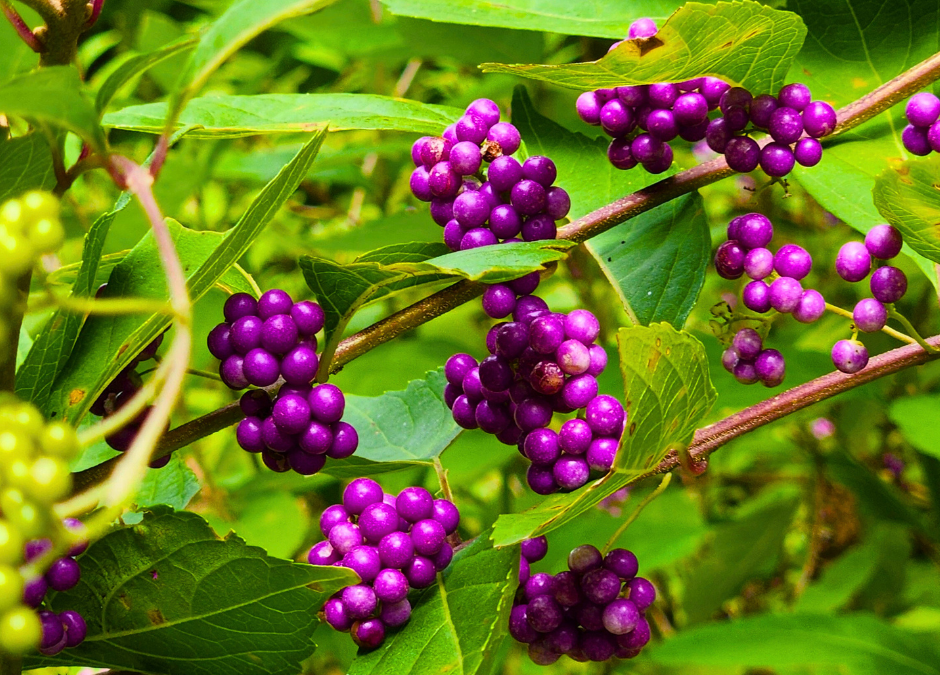
Today is all about the American Beautyberry (Callicarpa americana). This eye-catching plant provides flowers for tiny pollinators, berries and shelter for wildlife, and spectacular late summer/early fall interest for us gardeners. But beyond that, it also has a fascinating history of culinary, herbal, and even pest control uses.
Native to the central and southeastern United States, American Beautyberry is particularly memorable in late summer and fall, when clusters of intensely purple berries wrap around its arching stems. But those berries are only one part of what makes this plant special.
From its leaves to its flowers to its fruit, almost every part of American Beautyberry has something to offer. Let’s take a look.
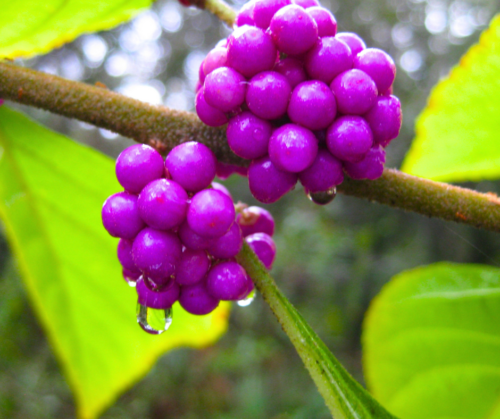
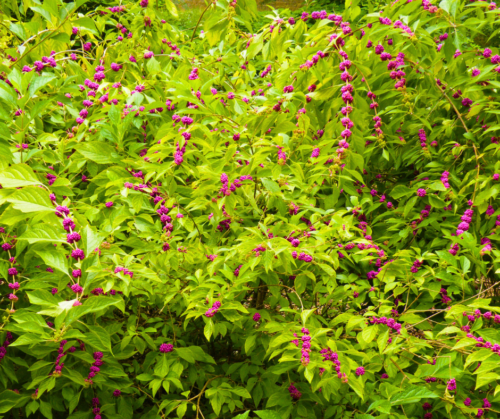
American Beautyberry is a deciduous native shrub with a naturally arching growth habit. Depending on conditions and pruning, mature plants generally reach about 4–8 feet tall and 4–8 feet wide. I love the informal look of this plant; it lends well to those gardeners who prefer leaving the pruners alone and allowing nature to take over.
In spring, fresh green leaves emerge along long stems. By late spring and early summer, small pink to lavender flowers appear in clusters where the leaves meet the stems. The flowers are almost inconspicuous, but some of our smaller pollinators sure do appreciate them. Those flowers eventually develop into the plant’s signature berries.
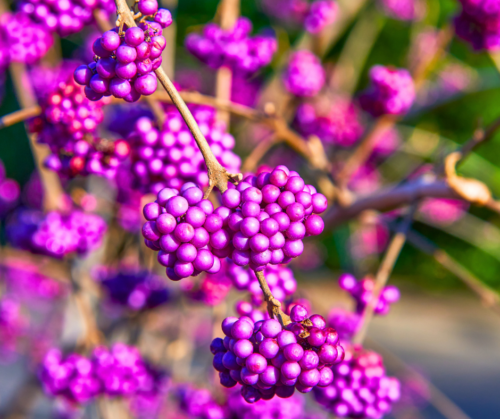
By late summer and fall, the berries develop on American Beautyberry and kind of take on an ombre pattern as they gradually ripen from the palest pink to an almost unbelievably bright magenta-purple. The clusters hug the stems rather than dangling from them, giving Beautyberry its distinctive appearance.
After the foliage drops in late fall/early winter, berries may remain on the bare branches, creating additional seasonal interest and a valuable food source for hungry wildlife.
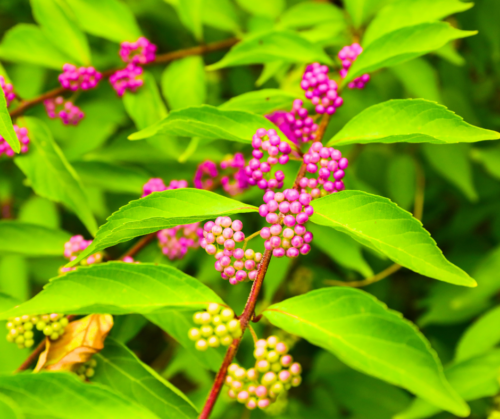
The Leaves: More Interesting Than They Look
Beautyberry’s broad green leaves may not receive the same attention as its purple fruit, but they’re an important part of this plant’s usefulness.
Natural Mosquito-Repelling Potential
This is one of the most fascinating things about American Beautyberry.
Beautyberry leaves have a long history of traditional use in the South as an insect repellent. Crushed leaves were reportedly rubbed on animals or placed beneath harnesses to help discourage biting insects.
Modern research has found some science behind that tradition.
Researchers with the USDA Agricultural Research Service isolated compounds from American Beautyberry leaves, including callicarpenal and intermedeol, that demonstrated repellent or biting-deterrent activity against certain mosquitoes and ticks in laboratory studies.
That doesn’t mean rubbing a Beautyberry leaf on your skin is the same as a dose of DEET. But it does mean this old-fashioned use of the plant has some fascinating scientific support. We made and used the DIY mosquito spray using American Beautyberry foliage, and we thought it actually DID keep more mosquitoes from biting us. Of course, some people are just mosquito magnets, but it might be worth a try.
Beautyberry is another great example of how native plants can contain complex natural compounds that we’re still learning about.
Traditional Herbal & Medicinal Uses
American Beautyberry also has a history of use in traditional herbal practices. Different parts of the plant have historically been prepared for a variety of purposes, including preparations associated with skin complaints, digestive issues and other ailments.
However, traditional use does not automatically mean a treatment has been proven safe or effective. Much of Beautyberry’s medicinal reputation comes from folk use rather than established clinical evidence.
For that reason, we recommend appreciating Beautyberry’s medicinal history as part of the plant’s fascinating story rather than using it to self-treat medical conditions. We got to cover ourselves here, ya know?
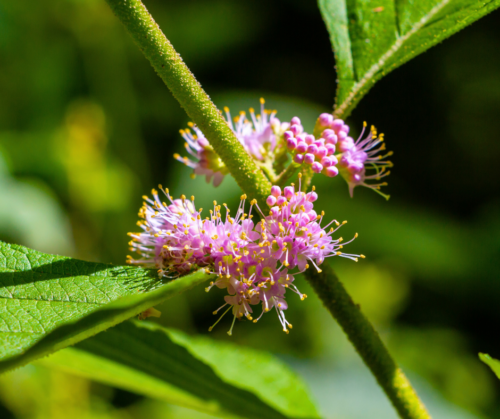
THE FLOWERS: Tiny Blooms With a Big Job
Before you get those gorgeous purple berries, you need flowers! It’s very exciting when these tiny flowers show up because you know the real show is about to start.
American Beautyberry produces clusters of small, fuzzy pink, lavender or pinkish-white flowers along its stems, generally from late spring through summer. These tiny but mighty blossoms are valuable because they provide nectar and pollen to visiting insects.
Beautyberry flowers attract:
- Native bees
- Honeybees
- Butterflies
- Other beneficial pollinating insects
Beautyberry can also contribute to the life cycle of native insects beyond simply providing nectar. It is reported as a larval host for species including the spring azure butterfly and snowberry clearwing moth.
THE BERRIES: A Fall Feast for Wildlife
This is when American Beautyberry really earns its name.
Beginning in late summer, clusters of green fruit gradually transform into spectacular magenta-purple berries that surround the stems. Make sure you are paying attention when the berries first start developing because they kind of creep up the stem, changing colors in an ombre effect. It’s really cool.
And while they’re beautiful to us, to wildlife, they’re some nutrient-rich food.
Numerous bird species consume Beautyberry fruit, and the berries are also eaten by small animals. The shrub’s dense, arching growth can provide additional shelter and cover, offering multiple resources to wildlife.
BEAUTYBERRY FOR US: Jams, Jellies & More
Wildlife isn’t the only thing that can enjoy Beautyberry fruit.
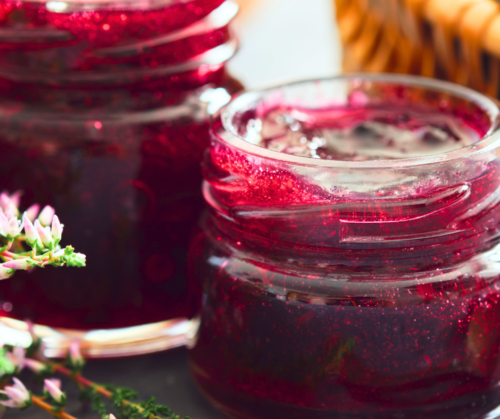
American Beautyberry has a history of culinary use, with the ripe berries most commonly turned into jams and jellies.
Raw Beautyberries aren’t usually considered a spectacular snacking berry. Their flavor and texture can be relatively mild, or sometimes a little astringent. But when you cook them, the magic happens.
Beautyberries can be used for:
- Beautyberry jelly
- Jam
- Syrup
- Sauces
- Fruit spreads
- Beverages
- Infused preparations
Beautyberry jelly is probably the classic preparation. The berries are cooked with water to release their juice, strained, and then combined with sugar and pectin to create a beautifully colored jelly. We did it and we loved it!
A Gorgeous Landscape Specimen: Where to plant Beautyberry
Even if Beautyberry didn’t benefit a single bird, bee or gardener, we’d still have a reason to plant it. We already talked about how gorgeous it looks, and the fact that it is a native specimen makes it all that more enticing.
Here are some favorite ways to use American Beautyberry, but by all means, these are not the only way to use this beautiful plant:
- Native plant gardens
- Pollinator gardens
- Wildlife gardens
- Woodland edges
- Naturalized areas
- Rain gardens
- Areas beneath or near large trees with filtered light
- Large landscape beds where it has room to arch naturally
Because the mature shrub can become several feet wide, avoid squeezing it into a narrow foundation bed where you’ll constantly have to prune it into submission. Beautyberry looks best when you give those long branches room to develop their naturally graceful form.
~The Happy Gardener, Lisa Mulroy


Do you never prune them, or do you prune back in February time frame ?? If you prune back, how much do you prune back ??
Hi Gwen,
They don’t need much pruning, but you can trim them back in late winter/early spring (generally mid to late Feb in San Antonio). Don’t take off more than 1/3 from the top, unless you are removing diseased or broken limbs.