


Oh, hey there! Are you tired of hearing us tell you that fall is the best time for planting trees and shrubs? Sorry, we just can’t stop yet. Fall really and truly is the best time for planting and November is the perfect month. Today is just about giving you a few extra tips to make sure that your tree plantings are as successful as they can be. Let’s plant some trees!
4 Extra Tips for Tree Planting Success
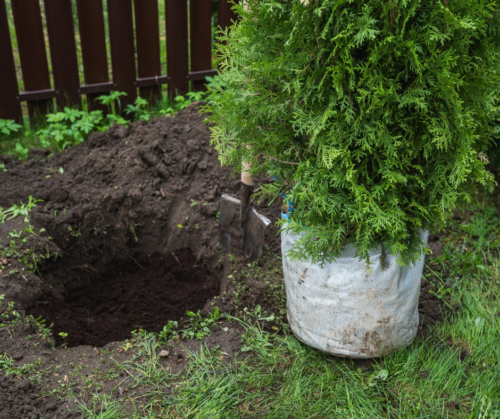
You don’t need a lot of supplies for planting trees successfully. The basics are a sharp shovel, something to measure the level of soil, your tree, a water source, possibly some soil conditioner, and mulch. Really, that’s kind of it for the supplies. The rest is all about choosing the right elements.
1. Space:
First, you want to make sure you have ample space for your tree to be planted in your landscape. That young tree you purchase in the nursery is going to get a lot bigger through the years. You’ll need to know the size of your tree at maturity in order to know if it will fit nicely where you think you want a tree. The chosen planting area must have a wide berth that won’t be impinged upon by overhead electric wires, underground cables (call 811 to check what’s underneath), and other surrounding structures. The last thing you want to do is find yourself hacking at your beautiful tree to try to make it fit in an area it has outgrown.
2. Drainage:
Most trees need good drainage. Roots of trees need plenty of oxygen and waterlogged soil depletes them of that pretty quickly. Don’t know if your soil drains well enough to plant a tree? You can do a simple test. Dig a hole where you plan to plant. Fill the hole with water and let it drain completely. Fill the hole with water once again and measure and time how long it takes to drain completely. Ideally, you want the water to drain about 1-2″ per hour. If after 24 hours, there is still water standing in the hole, it’s not a great location to plant a tree. You could choose to plant on a raised berm, but it’s probably best to find a new location that drains well.
3. Soil:
Generally, it’s best to just use native soil for tree planting. The soil you dig out of the hole, is the soil you use to backfill around the tree once it’s been planted. IF you have soil that is very sandy, or very rocky, compost or soil conditioner may be beneficial and can be added to the backfill; added and mixed. It’s important that if you do use compost or soil conditioner that you don’t just dump it into the bottom of the hole. You want to thoroughly mix any soil amendments with your native soil, so they are properly dispersed. But again, if you’re native soil is decent, that’s your best bet.
4. Mulch:
Mulch is the holy grail when it comes to tree planting. It’s an inexpensive but very efficient product that keeps moisture in the soil around your tree’s root system. Just because we don’t want waterlogged soil doesn’t mean we don’t want moisture in the soil. Mulch helps reduce evaporation, suppresses moisture and nutrient stealing weeds, and if you choose a good, organic mulch, it can also help feed the soil as it slowly breaks down over time. Mulch will help cool soil during the heat of summer and can help keep roots insulated during the cold of winter. In my opinion, mulch is a non-negotiable step to successful tree planting.
Once you’ve got a good grasp of these 4 extra tips for successful tree planting, the rest is pretty easy when you follow the steps in our Tree and Shrub Planting Guide. Be mindful of the size of your planting hole, make sure you don’t plant too deep (the top of the rootball should be at surrounding soil level or slightly higher), and follow our watering guide to get your tree established. Planting now in fall allows your tree to develop a strong root system all through winter so your tree can survive and thrive through its first summer in San Antonio.
So come on in to either one of our Rainbow Gardens locations now because we have a great selection of trees for you to choose from. Fall is for planting and fall is now!
~The Happy Gardener, Lisa Mulroy


