


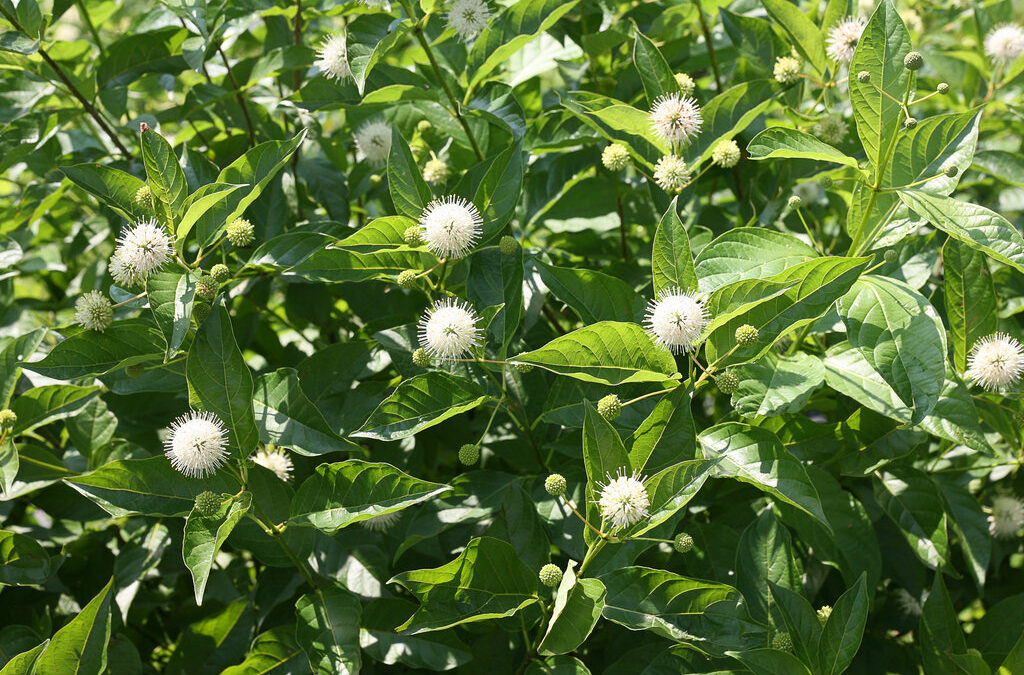
Follow us through a couple of seasons and you’ll most likely hear of one of our favorite native shrubs that brings pollinators in by the hordes. We’re talking about Buttonbush (Cephalanthus occidentalis). White puffy spheres cover the plant from summer to fall and beckon to hungry local butterflies and bees that zoom in for a guaranteed sip of nectar. If you’ve fallen in love with those pincushion-puffballs as much as we have, today’s announcement just might send you over the edge. Our Thousand Oaks location has secured a shipment of…pause for effect… Sugar Shack® DWARF BUTTONBUSH!
That’s right. Dwarf Buttonbush has all the amazing characteristics we love about the standard form, but it’s all wrapped up in a compact form that is perfect for smaller landscapes and container gardens. Oh joy, oh happiness! Let’s take a closer look and fall in love all over again.
Sugar Shack® Dwarf Buttonbush: Quick Look Characteristics
- Size: 3-4′ T x W
- Light: Sun to part sun
- Soil: Best in moist soils
- Bloom time: Summer to fall
- Blooms: White, fuzzy spherical, fragrant
- Fruit: Red seedheads in fall/winter
- Foliage: Glossy green in spring/summer changes to burgundy in fall
- Pollinator Interest: Butterflies, Hummingbirds, Bees, Birds
- Deciduous
- Hardiness Zone 4a – 10b
- Native shrub
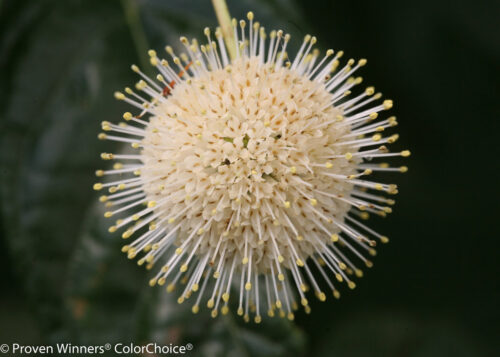
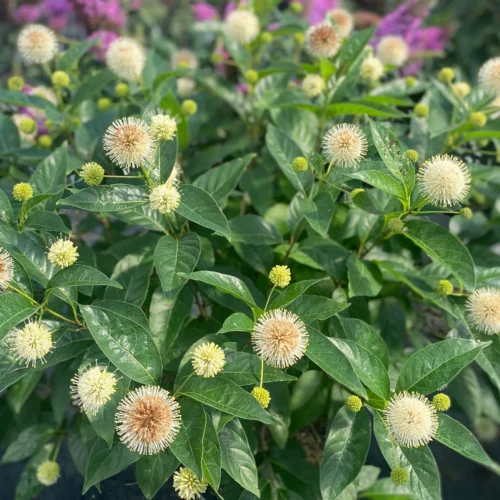
Sugar Shack® dwarf buttonbush is a delight. Its smaller size, 5′ T x 5′ W, as compared to the standard size 12′ T x 8′ W, allows it to fit in smaller landscapes and patio gardens. In containers, its mature growth is generally even more compact (30-50% smaller) restricted by the size of the container you choose. This gives you a lot of flexibility for where you can place your dwarf buttonbush. I’ve always loved buttonbush, but I struggled finding a large enough spot in my landscape to be able to feature it properly. Looks like my problem has been solved with the Sugar Shack® compact variety.
Sun to part sun is the recommended light exposure for the main attraction, the blooms! Given too much shade, your dwarf buttonbush will provide you with plenty of foliage, but you’ll miss out on the creamy-white puffballs that give this plant its name. These intriguing blooms carry a heavy, creamy, honey-like scent that is as irresistible to pollinators and beneficial insects as it is to a human nose within its range. But good news, deer generally resist it; the fragrance is unpleasant to them, and the leaves are too bitter for their palate. These spherical flowers pop out in summer and can bloom into fall. Their white creamy color transforms to a burnt-red color when they become seedheads in fall. Pair that with foliage color change from glossy green to burgundy and you’ve got a stunner of a landscape specimen (or container arrangement).
Sugar Shack® dwarf buttonbush’s compact size makes it an excellent choice for the middle of a layered garden bed, with shorter border plants in front and taller specimen plants behind. In containers it can make a stunning “thriller” plant in “thriller, filler, spiller” arrangements. Although, make no mistake, this plant can without a doubt stand on its own as a lone specimen potted plant as well. We love when a new variety of great plant checks all the boxes.
If you noticed in the ‘quick characteristics’ section above, buttonbush prefers consistently moist soil. While this may make some gasp and wonder how we can recommend a water-loving plant in San Antonio, it’s important to know that some of us struggle with areas in our landscape that simply don’t drain well. Buttonbush is healthiest, most fragrant, and thriving when it’s given regular water. It can even live happily in areas that tend to have standing water. If you have water runoff areas that have always been difficult for plants, this could be your problem solver right here. Buttonbush is an outstanding and underused native shrub for wet gardens, rain gardens, and naturalized wet areas.
Don’t let the fact that it likes water make you think it can’t handle the heat of our summers. Hot temperatures are its sweet spot, and it gets the flowers blooming. Conversely, buttonbush is also extremely cold tolerant. Through winters in our San Antonio area, the plant is hardy to 15º F, and very rarely do we see that temperature making this compact shrub a reliable landscape plant. During extreme or prolonged periods of freezing weather, its cold tolerance is 30º F, and that is still pretty darn good. We don’t generally have long, extended cold snaps so I feel good recommending this one.
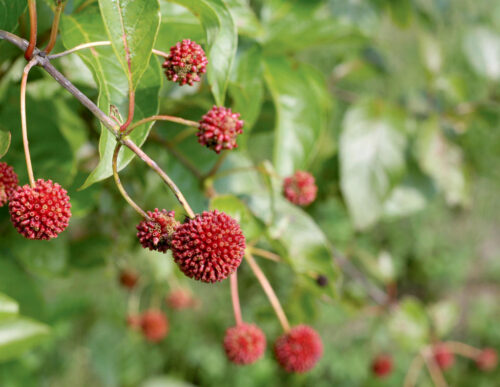
Let’s return for a moment to our beloved pollinators. If you are a gardener who loves looking out into the garden and seeing a flurry of movement, activity, and well, life, the native dwarf buttonbush is going to give you that and then some. Because the pincushion-textured blooms are borne at the end of long stalks, it makes them highly visible to visiting pollinators. With its bloom season lasting from June to October, pollinators are treated to nectar through summer when sometimes options for food are scarce due to the heat shutting down the blooms of many perennials. Bees, butterflies, and hummingbirds whip themselves up in a tizzy. When late fall and winter arrive, the flowers treat our local birds to nourishing seedheads. This truly is very valuable native shrub for wildlife. (P.S. In areas where buttonbush is planted alongside ponds and streams, its submerged roots create habitats and refuge for fish and other aquatic creatures. Bonus!)
One thing of note. While deciduous, buttonbush is usually one of the last native shrubs to have its leaves turn yellow before dropping. This gives you a long period of foliage color fall interest. When winter is winding down and signs of spring are developing, don’t get worried that nothing is happening right away with your buttonbush. They are also generally one of the last native shrubs to leaf out in spring. Maybe we should start using buttonbush as a clue to the arrival of true spring instead of Mr. Groundhog.
I just can’t say enough about this plant. It’s native, unique looking, compact and versatile, deer resistant, and fills up the bellies of our local pollinators and wildlife. What’s not to love? I’d come get yours at our Thousand Oaks location right away. once the word gets out, we’ll be out!
~The Happy Gardener, Lisa Mulroy


